


100-150 Study Guide Brilliant 100-150 Exam Dumps PDF
View 100-150 Exam Question Dumps With Latest Demo
NEW QUESTION # 23
You want to list the IPv4 addresses associated with the host name www.companypro.net.
Complete the command by selecting the correct option from each drop-down list.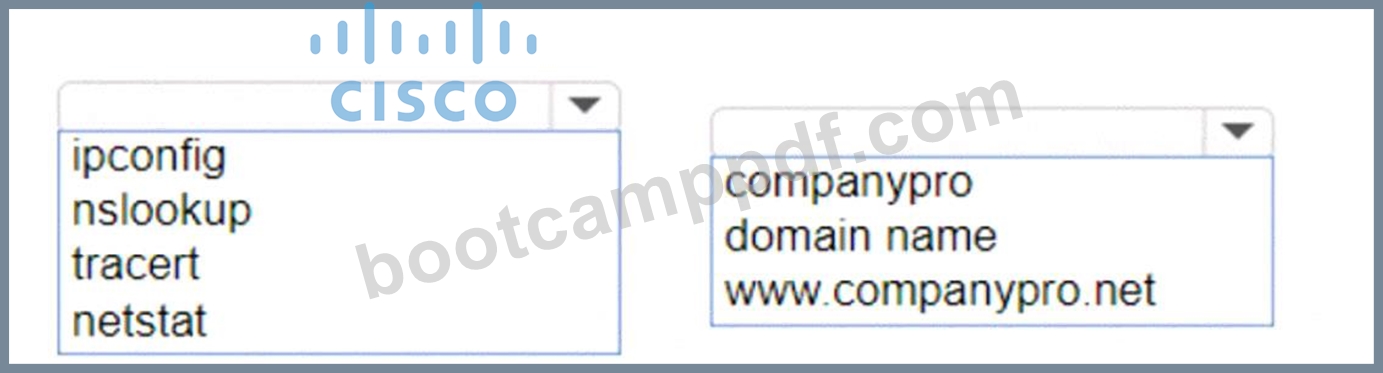
Answer:
Explanation:
Explanation:
To list the IPv4 addresses associated with the host name www.companypro.net, you should use the following command:
nslookup www.companypro.net
This command will query the DNS servers to find the IP address associated with the hostname provided. If you want to ensure that it returns the IPv4 address, you can specify the -type=A option, which stands for Address records that hold IPv4 addresses1. However, the nslookup command by default should return the IPv4 address if available.
To list the IPv4 addresses associated with the host name www.companypro.net, you should use the nslookup command.
* Command: nslookup
* Target: www.companypro.net
So, the completed command is:
* nslookup www.companypro.net
* nslookup: This command is used to query the Domain Name System (DNS) to obtain domain name or IP address mapping or for any other specific DNS record.
* www.companypro.net: This is the domain name you want to query to obtain its associated IP addresses.
References:
* Using nslookup: nslookup Command Guide
NEW QUESTION # 24
Which protocol allows you to securely upload files to another computer on the internet?
- A. NTP
- B. HTTP
- C. SFTP
- D. ICMP
Answer: C
Explanation:
SFTP, or Secure File Transfer Protocol, is a protocol that allows for secure file transfer capabilities between networked hosts. It is a secure extension of the File Transfer Protocol (FTP). SFTP encrypts both commands and data, preventing passwords and sensitive information from being transmitted openly over the network. It is typically used for secure file transfers over the internet and is built on the Secure Shell (SSH) protocol1.
Reference: =
* What Is SFTP? (Secure File Transfer Protocol)
* How to Use SFTP to Safely Transfer Files: A Step-by-Step Guide
* Secure File Transfers: Best Practices, Protocols And Tools
The Secure File Transfer Protocol (SFTP) is a secure version of the File Transfer Protocol (FTP) that uses SSH (Secure Shell) to encrypt all commands and data. This ensures that sensitive information, such as usernames, passwords, and files being transferred, are securely transmitted over the network.
* ICMP (Internet Control Message Protocol) is used for network diagnostics and is not designed for file transfer.
* NTP (Network Time Protocol) is used to synchronize clocks between computer systems and is not related to file transfer.
* HTTP (HyperText Transfer Protocol) is used for transmitting web pages over the internet and does not inherently provide secure file transfer capabilities.
Thus, the correct protocol that allows secure uploading of files to another computer on the internet is SFTP.
Reference: =
* Cisco Learning Network
* SFTP Overview (Cisco)
NEW QUESTION # 25
Examine the following output:
Which two conclusions can you make from the output of the tracert command? Note: You will receive partial credit for each correct answer. (Choose 2.)
- A. The routers at hops 5 and 6 are offline.
- B. The trace failed after the fourth hop.
- C. The device sending the trace has IPv6 address 2600:1408:c400:38d :: b33.
- D. The IPv6 address associated with the www.cisco.com server is 2600:1408: c400: 38d: : b33.
- E. The trace successfully reached the www.cisco.com server.
Answer: D,E
Explanation:
* Statement A: "The trace successfully reached the www.cisco.com server." This is true as indicated by the "Trace complete" message at the end, showing that the trace has reached its destination.
* Statement C: "The IPv6 address associated with the www.cisco.com server is
2600:1408:c400:38d::b33." This is true because the final hop in the trace, which is the destination, has this IPv6 address.
* Statement B: "The trace failed after the fourth hop." This is incorrect as the trace continues beyond the fourth hop, despite some intermediate timeouts.
* Statement D: "The routers at hops 5 and 6 are offline." This is not necessarily true. The routers might be configured to not respond to traceroute requests.
* Statement E: "The device sending the trace has IPv6 address 2600:1408:c400:38d::b33." This is incorrect; this address belongs to the destination server, not the sender.
Reference: * Understanding Traceroute: Traceroute Guide
NEW QUESTION # 26
Move each cloud computing service model from the list on the left to the correct example on the right Note: You will receive partial credit for each correct answer.
Answer:
Explanation: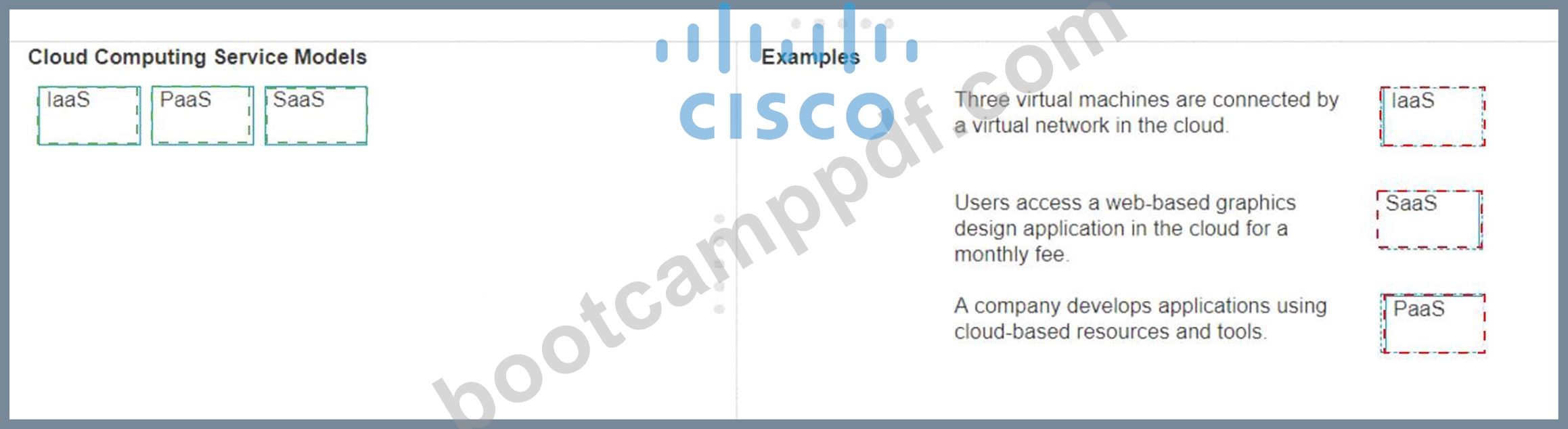
Explanation:
* Three virtual machines are connected by a virtual network in the cloud.
* Model: IaaS (Infrastructure as a Service)
* Explanation: IaaS provides virtualized computing resources over the internet, including virtual machines, storage, and networks.
* Users access a web-based graphics design application in the cloud for a monthly fee.
* Model: SaaS (Software as a Service)
* Explanation: SaaS delivers software applications over the internet, typically on a subscription basis, accessible via a web browser.
* A company develops applications using cloud-based resources and tools.
* Model: PaaS (Platform as a Service)
* Explanation: PaaS provides a platform allowing customers to develop, run, and manage applications without dealing with the infrastructure.
* IaaS (Infrastructure as a Service): Provides virtualized hardware resources that customers can use to build their own computing environments.
* PaaS (Platform as a Service): Offers a platform with tools and services to develop, test, and deploy applications.
* SaaS (Software as a Service): Delivers fully functional applications over the internet that users can access and use without managing the underlying infrastructure.
References:
* Cloud Service Models: Understanding IaaS, PaaS, SaaS
* NIST Definition of Cloud Computing: NIST Cloud Computing
NEW QUESTION # 27
A local company requires two networks in two new buildings. The addresses used in these networks must be in the private network range.
Which two address ranges should the company use? Note: You will receive partial credit for each correct selection. (Choose 2.)
- A. 192.168.0.0 to 192.168.255.255
- B. 11.0.0.0 to 11.255.255.255
- C. 172.16.0.0 to 172.31.255.255
- D. 192.16.0.0 to 192.16.255.255
Answer: A,C
Explanation:
The private IP address ranges that are set aside specifically for use within private networks and not routable on the internet are as follows:
Class A: 10.0.0.0 to 10.255.255.255
Class B: 172.16.0.0 to 172.31.255.255
Class C: 192.168.0.0 to 192.168.255.255
These ranges are defined by the Internet Assigned Numbers Authority (IANA) and are used for local communications within a private network123.
Given the options:
A). 172.16.0.0 to 172.31.255.255 falls within the Class B private range.
B). 192.16.0.0 to 192.16.255.255 is not a recognized private IP range.
C). 11.0.0.0 to 11.255.255.255 is not a recognized private IP range.
D). 192.168.0.0 to 192.168.255.255 falls within the Class C private range.
Therefore, the correct selections that the company should use for their private networks are A and D.
Reference: =
Reserved IP addresses on Wikipedia
Private IP Addresses in Networking - GeeksforGeeks
Understanding Private IP Ranges, Uses, Benefits, and Warnings
NEW QUESTION # 28
Which command will display all the current operational settings configured on a Cisco router?
- A. show protocols
- B. show startup-config
- C. show running-config
- D. show version
Answer: C
Explanation:
The show running-config command is used on a Cisco router to display the current operational settings that are actively configured in the router's RAM. This command outputs all the configurations that are currently being executed by the router, which includes interface configurations, routing protocols, access lists, and other settings. Unlike show startup-config, which shows the saved configuration that the router will use on the next reboot, show running-config reflects the live, current configuration in use.
Reference: = The information is supported by multiple sources that detail the use of Cisco commands, particularly the show running-config command as the standard for viewing the active configuration on a Cisco device123.
show running-config: This command displays the current configuration running on the router. It includes all the operational settings and configurations applied to the router.
show protocols: This command shows the status of configured protocols on the router but not the entire configuration.
show startup-config: This command displays the configuration saved in NVRAM, which is used to initialize the router on startup, but not necessarily the current running configuration.
show version: This command provides information about the router's software version, hardware components, and uptime but does not display the running configuration.
Reference: Cisco IOS Commands: Cisco IOS Commands
NEW QUESTION # 29
A Cisco PoE switch is shown in the following image.
Which type of port will provide both data connectivity and power to an IP phone?
- A. Ports identified with number 7
- B. Ports identified with numbers 3 and 4
- C. Port identified with number 2
- D. Ports identified with number 6
Answer: D
Explanation:
In the provided image of the Cisco PoE switch, the ports identified with number 6 are the standard RJ-45 Ethernet ports typically found on switches that provide both data connectivity and Power over Ethernet (PoE). PoE ports are designed to supply power to devices such as IP phones, wireless access points, and other PoE-enabled devices directly through the Ethernet cable.
Ports:
* 2: Console port (for management and configuration)
* 3 and 4: Specific function ports (often for management)
* 6: RJ-45 Ethernet ports (capable of providing PoE)
* 7: SFP ports (for fiber connections, typically do not provide PoE) Thus, the correct answer is C. Ports identified with number 6.
Reference: =
* Cisco Catalyst 2960-L Series Switches Data Sheet
* Cisco PoE Overview
NEW QUESTION # 30
HOTSPOT
You purchase a new Cisco switch, turn it on, and connect to its console port. You then run the following command:
For each statement about the output, select True or False. Note: You will receive partial credit for each correct selection.
Answer:
Explanation:
Explanation:
The two interfaces are administratively shut down:
False: The output does not show any "shutdown" command under the interfaces, which would indicate that they are administratively shut down. Therefore, they are likely in their default state, which is administratively up.
The two interfaces have default IP addresses assigned:
False: The output does not show any IP address configuration. In the default state, interfaces do not have IP addresses assigned unless explicitly configured.
The two interfaces can communicate over Layer 2:
True: By default, interfaces on a switch are Layer 2 interfaces capable of forwarding Ethernet frames. As there is no configuration provided that changes this, it can be assumed they can communicate over Layer 2.
Interface Status: The absence of the "shutdown" command means the interfaces are not administratively shut down.
IP Address Assignment: There is no evidence in the output that IP addresses have been assigned to the interfaces, which would typically be shown as "ip address" entries.
Layer 2 Communication: Switch interfaces in their default state operate at Layer 2, enabling them to forward Ethernet frames and participate in Layer 2 communication.
Reference: Cisco IOS Interface Configuration: Cisco Interface Configuration
Understanding Cisco Switch Interfaces: Cisco Switch Interfaces
NEW QUESTION # 31
Computers in a small office are unable to access companypro.net. You run the ipconfig command on one of the computers. The results are shown in the exhibit.
You need to determine if you can reach the router.
Which command should you use? Complete the command by selecting the correct options from each drop- down lists.
Answer:
Explanation:
Explanation:
To determine if you can reach the router, you should use the ping command followed by the IP address of the router. The ping command is a network utility used to test the reachability of a host on an Internet Protocol (IP) network and to measure the round-trip time for messages sent from the originating host to a destination computer.
The Default Gateway in the ipconfig results is typically the router's IP address in a home or small office network. In this case, the Default Gateway is 192.168.0.1, which is the address you would ping to check connectivity to the router.
References :=
* How to Use the Ping Command
* Testing Network Connectivity with the Ping Command
To determine if you can reach the router, you should use the ping command with the IP address of the router.
* Command: ping
* Target: 192.168.0.1
So, the completed command is:
* ping 192.168.0.1
Step by Step Comprehensive and Detailed Explanation:
* ping: The ping command sends ICMP Echo Request messages to the target IP address and waits for an Echo Reply. It is commonly used to test the reachability of a network device.
* 192.168.0.1: This is the IP address of the default gateway (the router) as shown in the ipconfig output.
Pinging this address will help determine if the computer can communicate with the router.
References:
* Using the ping Command: ping Command Guide
NEW QUESTION # 32
A user reports that a company website is not available. The help desk technician issues a tracert command to determine if the server hosting the website is reachable over the network.
The output of the command is shown as follows:
What can you tell from the command output?
- A. The router at hop 3 is not forwarding packets to the IP address 192.168.1.10.
- B. Requests to the web server at 192.168.1.10 are being delayed and time out.
- C. The server address 192.168.1.10 is being blocked by a firewall on the router at hop 3.
- D. The server with the address 192.168.1.10 is reachable over the network.
Answer: D
Explanation:
The tracert command output shows the path taken to reach the destination IP address, 192.168.1.10.
The command output indicates:
* Hops 1 and 2 are successfully reached.
* Hop 3 times out, meaning the router at hop 3 did not respond to the tracert request.
However, this does not necessarily indicate a problem with forwarding packets, as some routers may be configured to block or not respond to ICMP requests.
* Hops 4 and 5 are successfully reached, with hop 5 being the destination IP 192.168.1.10, indicating that the server is reachable.
Thus, the correct answer is C. The server with the address 192.168.1.10 is reachable over the network.
Reference: =
* Cisco Traceroute Command
* Understanding Traceroute
The tracert command output indicates that the server with the address 192.168.1.10 is reachable over the network. The asterisk (*) at hop 3 suggests that the probe sent to that hop did not return a response, which could be due to a variety of reasons such as a firewall blocking ICMP packets or the router at that hop being configured not to respond to ICMP requests. However, since the subsequent hops (4 and 5) are showing response times, it means that the packets are indeed getting through and the server is reachable12.
Reference: =
* How to Use Traceroute Command to Read Its Results
* How to Use the Tracert Command in Windows
NEW QUESTION # 33
Move each protocol from the list on the left to its correct example on the right.
Answer:
Explanation:
Explanation:
The correct matching of the protocols to their examples is as follows:
* DHCP: Assign the reserved IP address 10.10.10.200 to a web server at your company.
* DNS: Perform a query to translate companypro.net to an IP address.
* ICMP: Perform a ping to ensure that a server is responding to network connections.
Here's how each protocol corresponds to its example:
* DHCP (Dynamic Host Configuration Protocol) is used to assign IP addresses to devices on a network. In this case, DHCP would be used to assign the reserved IP address 10.10.10.200 to a web server.
* DNS (Domain Name System) is used to translate domain names into IP addresses. Therefore, to translate companypro.net to an IP address, DNS would be utilized.
* ICMP (Internet Control Message Protocol) is used for sending error messages and operational information indicating success or failure when communicating with another IP address. An example of this is using the ping command to check if a server is responding to network connections.
These protocols are essential for the smooth operation of networks and the internet.
* Perform a query to translate companypro.net to an IP address.
* DNS (Domain Name System): DNS is used to resolve domain names to IP addresses.
* Assign the reserved IP address 10.10.10.200 to a web server at your company.
* DHCP (Dynamic Host Configuration Protocol): DHCP is used to assign IP addresses to devices on a network.
* Perform a ping to ensure that a server is responding to network connections.
* ICMP (Internet Control Message Protocol): ICMP is used by network devices to send error messages and operational information, and it is the protocol used by the ping command.
* DNS (Domain Name System): DNS translates human-friendly domain names like "companypro.net" into IP addresses that computers use to identify each other on the network.
* DHCP (Dynamic Host Configuration Protocol): DHCP automatically assigns IP addresses to devices on a network, ensuring that no two devices have the same IP address.
* ICMP (Internet Control Message Protocol): ICMP is used for diagnostic or control purposes, and the ping command uses ICMP to test the reachability of a host on an IP network.
References:
* DNS Basics: What is DNS?
* DHCP Overview: What is DHCP?
* ICMP and Ping: Understanding ICMP
NEW QUESTION # 34
Which command will display the following output?
- A. show ip interface
- B. show cdp neighbor
- C. show inventory
- D. show mac-address-table
Answer: B
Explanation:
The command that will display the output provided, which includes capability codes, local interface details, device IDs, hold times, and platform port ID capabilities, is the show cdp neighbor command. This command is used in Cisco devices to display current information about neighboring devices detected by Cisco Discovery Protocol (CDP), which includes details such as the interface through which the neighbor is connected, the type of device, and the port ID of the device1.
Reference: =
* Cisco - show cdp neighbors
The provided output is from the Cisco Discovery Protocol (CDP) neighbor table. The show cdp neighbor command displays information about directly connected Cisco devices, including Device ID, Local Interface, Holdtime, Capability, Platform, and Port ID.
* A. show mac-address-table: Displays the MAC address table on the switch.
* C. show inventory: Displays information about the hardware inventory of the device.
* D. show ip interface: Displays IP interface status and configuration.
Thus, the correct answer is B. show cdp neighbor.
Reference: =
* Cisco CDP Neighbor Command
* Understanding CDP
NEW QUESTION # 35
A user initiates a trouble ticket stating that an external web page is not loading. You determine that other resources both internal and external are still reachable.
Which command can you use to help locate where the issue is in the network path to the external web page?
- A. ipconfig/all
- B. tracert
- C. ping -t
- D. nslookup
Answer: B
Explanation:
The tracert command is used to determine the route taken by packets across an IP network. When a user reports that an external web page is not loading, while other resources are accessible, it suggests there might be an issue at a certain point in the network path to the specific web page. The tracert command helps to diagnose where the breakdown occurs by displaying a list of routers that the packets pass through on their way to the destination. It can identify the network segment where the packets stop progressing, which is valuable for pinpointing where the connectivity issue lies. References := Cisco CCST Networking Certification FAQs - CISCONET Training Solutions, Command Prompt (CMD): 10 network-related commands you should know, Network Troubleshooting Commands Guide: Windows, Mac & Linux - Comparitech, How to Use the Traceroute and Ping Commands to Troubleshoot Network, Network Troubleshooting Techniques: Ping, Traceroute, PathPing.
*tracert Command: This command is used to determine the path packets take to reach a destination. It lists all the hops (routers) along the way and can help identify where the delay or failure occurs.
*ping -t: This command sends continuous ping requests and is useful for determining if a host is reachable but does not provide path information.
*ipconfig /all: This command displays all current TCP/IP network configuration values and can be used to verify network settings but not to trace a network path.
*nslookup: This command queries the DNS to obtain domain name or IP address mapping, useful for DNS issues but not for tracing network paths.
References:
*Microsoft tracert Command: tracert Command Guide
*Troubleshooting Network Issues with tracert: Network Troubleshooting Guide
NEW QUESTION # 36
Which standard contains the specifications for Wi-Fi networks?
- A. IEEE 802.11
- B. IEEE 802.3
- C. EIA/TIA 568A
- D. GSM
- E. LTE
Answer: A
Explanation:
The IEEE 802.11 standard contains the specifications for Wi-Fi networks. It is a set of media access control (MAC) and physical layer (PHY) specifications for implementing wireless local area network (WLAN) computer communication in various frequencies, including but not limited to 2.4 GHz, 5 GHz, and 6 GHz1. This standard is maintained by the Institute of Electrical and Electronics Engineers (IEEE) and is commonly referred to as Wi-Fi. The standard has evolved over time to include several amendments that improve speed, range, and reliability of wireless networks.
Reference: =
* The Most Common Wi-Fi Standards and Types, Explained
* 802.11 Standards Explained: 802.11ax, 802.11ac, 802.11b/g/n, 802.11a
* Wi-Fi Standards Explained - GeeksforGeeks
NEW QUESTION # 37
What is the most compressed valid format of the IPv6 address 2001 :0db8:0000:0016:0000:001b: 2000:0056?
- A. 2001:db8: : 16: : 1b:2:56
- B. 2001:db8: 0:16: :1b: 2000:56
- C. 2001:db8: 16: :1b:2:56
- D. 2001:db8: : 16: : 1b: 2000: 56
Answer: B
Explanation:
IPv6 addresses can be compressed by removing leading zeros and replacing consecutive groups of zeros with a double colon (::). Here's how to compress the address 2001:0db8:0000:0016:0000:001b:2000:0056:
* Remove leading zeros from each segment:
* 2001:db8:0000:0016:0000:001b:2000:0056 becomes 2001:db8:0:16:0:1b:2000:56
* Replace the longest sequence of consecutive zeros with a double colon (::). In this case, the two consecutive zeros between the 16 and 1b:
* 2001:db8:0:16::1b:2000:56
Thus, the most compressed valid format of the IPv6 address is 2001:db8:0:16::1b:2000:56.
References :=
* Cisco Learning Network
* IPv6 Addressing (Cisco)
NEW QUESTION # 38
......
Free 100-150 Test Questions Real Practice Test Questions: https://passleader.bootcamppdf.com/100-150-exam-actual-tests.html